• Friday, December 11th, 2009
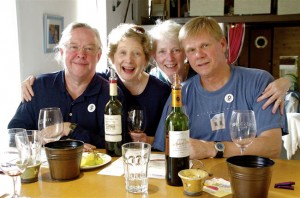 Recently Brian and I hosted a Signature French Wine Tasting with two friendly couples from Virginia, one of whom even owns their own vineyard called Democracy Vineyards. As you may have guessed from the winery’s name, Susan and Jim are both very much into politics (they used to work as lobbyists in Washington, DC). In this season of their life, they have combined patriotism with their love of wine and viticulture and keep busy in Virginia choosing which vines to plant, deciding the layout of the winery, making the wine themselves, and of course, coming up with all of the marketing.
It was interesting discussing the differences between French and American wines and how opposite the two industries are in terms of both wine making and marketing. This is a subject that we talk about often at our tastings. From the differences in tasting room culture to the different ways that bottles are labeled, the confusion can quickly become overwhelming. More than simply teaching people how to taste wine, Brian and I attempt to demystify the world of French wine, one guest at a time. Come join us!
• Monday, December 07th, 2009
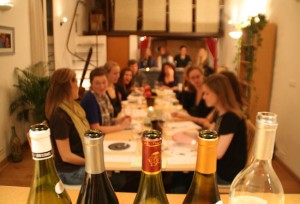
Brian and I just had our last student tasting for 2009. We led about 20 students through a flight of French wines. We both love educating college students because they typically haven’t had much exposure to wine so they’re like blank slates! We can get them started on a lifetime of tasting and enjoying great wine.
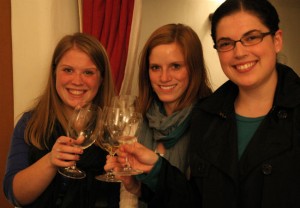

It happened to be Beaujolais Nouveau night, so of course we had to try some! Beaujolais is a wine region in the middle of France where Gamay is the most commonly grown grape. Gamay is typically used as a blending grape, meaning that it’s very rare to have 100% gamay in a bottle. However, since that’s one of the only varietals that grows well in that region the winemakers aren’t left with many choices. Since it doesn’t hold it’s own against other high quality bottles produced in France, sales suffer. The wine producers in this region got together and came up with the idea of Beaujolais Nouveau (where the wine is bottled and drank immediately after harvesting) as a means to sell their less than stellar wine. The marketing ploy worked and now people around the world celebrate the release of this 7-9 week old red wine on the third Thursday in November.
The cheaper bottles of Beaujolais Nouveau will taste like purple popsicles and the better ones won’t taste quite like the wine you are used to drinking, but instead will have a raw berry taste (almost like drinking grape juice). It’s one of the few wines that is meant to be gulped and not sipped 
• Wednesday, November 25th, 2009
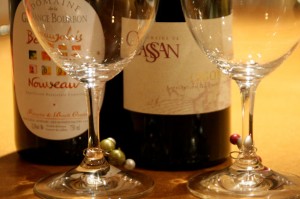
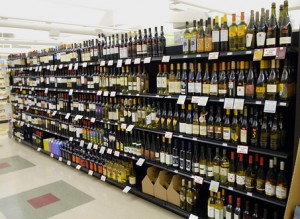 We’ve all been there before. Standing in front of hundreds of bottles of wine, utterly confused as to which one to pick. It can be a daunting, if not overwhelming task. A lot of our guests ask us during our tastings how they can better pick out wines at the store. We could write a whole book on the subject, but for brevity’s sake, we’ve come up with 5 questions to ask before purchasing a bottle of wine.
1. What foods complement/detract from it? Or is it a wine that is best drunk alone?
This is probably the most important question to ask. A bad pairing can make a good wine taste only OK, whereas the perfect pairing can make a bottle of wine the highlight of the evening.
2. Should it be chilled?
Almost all whites, rosés, and champagnes need to be chilled. The vast majority of reds are to be served at room temperature. However, certain reds (namely Beaujolais of France) can be chilled slightly if desired.
3. What is the ideal age to drink the wine?
With a few exceptions on some high-end white wines, whites and rosés need to be drunk within 3-5 years. For reds, this can vary widely so it’s really best to ask the wine shop staff, or call the winery directly. A quick Google search is also a good place to find out when a particular bottle should be drunk.
4. If not shown on the label, which grape varietal is in the bottle?
Most French wine labels only show the region, so some investigating will need to be done as to which grapes are grown in the region.
5. Will it need to be decanted?
For certain reds (usually the stronger, more tannic ones), decanting the wine can make all the difference. Some wines can be opened up to 24 hours ahead of time.
• Tuesday, November 10th, 2009
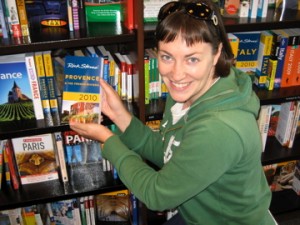
Hello fellow wine tasters! My husband, Dominic, and I have been traveling on both the East and West Coasts of the U.S. for the last few weeks (Brian has been doing a wonderful job handling the tastings in Aix). I’ve hosted wine tastings in each of the 11 cities Dominic and I have visited- so fun! We compared French and American wines (Chardonnay, Rose, and Syrah- a bottle from each country). The Rick Steves book came out while I was in Virginia, so here’s a picture of me SOOOO excited finding it on the shelf in a Barnes & Nobles book store. (I made my husband take tons of pictures, but I’m going to spare you and just put one up =) We return to France tomorrow, so soon, I will write again with a bit more detail on the wine events I led in North America and which WineInProvence friends I got a chance to see while I was there!
• Thursday, October 29th, 2009
 Hilary and I are so excited today because the new Rick Steves’ “Provence and the French Riviera 2010″ came out today and WineInProvence is featured in Aix en Provence! We had been hoping to become a part of these excellent travel guides for some time now. We have always felt that WineInProvence is the perfect fit for Rick Steves’ guide books because we give people an insight into the local culture (food and wine!), work with local merchants, and keep our groups small in order to create a friendly atmosphere for our guests.
Here is the excerpt from the guidebook:
“At WineInProvence, just-happy-to-be-here Americans Hilary and Brian want to help you discover French wine in a fun, relaxed setting. Their dream is to show you a side of Provence that you wouldn’t otherwise see: through the lens of French wines.”
If you are interested in ordering the book, click here to purchase it from Amazon.com
• Wednesday, September 30th, 2009
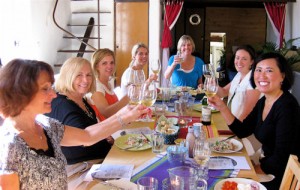 This past week, I had a group of women who decided to leave their men at the hotel and join me for our Market Day Cooking Class. It worked out perfectly because Brian was out of the country for the week, making it truly an all female affair. One of the most exciting things about what we do is giving people the chance to meet fellow travelers. For this group, we had women from both the east and west coasts of the United States.

In this post, I wanted to highlight one of our favorite recipes that we’ve learned from Chef Caroline: Vanilla Salmon Tartar.
This dish is unique in that you don’t actually cook the salmon in the traditional way (oven, grill, etc.). The acid from the lemon and the shallots lightly cook the salmon and with the addition of the fresh vanilla beans makes this dish both refreshing and delicious.
We’ve added the recipe below for you to enjoy at home.
Vanilla Salmon Tartar Recipe
Ingredients
Fresh salmon filet: 0.640 Kg
Schalotts: 0.150 Kg
Sea salt: 0.002 Kg
Fresh ground pepper: pinch
Lemon: 3
Vanilla beans: 2 Beans
Olive oil: 0.003 Liters
Directions
1 - Start by skinning the fish and removing the bones.
2 - Dice the fish into small pieces (1/4 inch cubes). The smaller your slices are, the more they will cook.
3 - Peel the shallots, and chop them thinly.
4 - Cut the vanilla beans in half the long way and scrape out all the “seeds” with the back of a knife.
5 - Juice the lemons and take out the seeds.
6 - Mix all ingredients in a large bowl.
7 - Leave out for a minimum of 1 hour or 1h30 in the fridge.
• Friday, September 25th, 2009
Some exciting news for WineInProvence this past week: we were approached to be on TV!
The Travel Channel commissioned “Around The World Productions” to shoot an episode based around activities that tourists can do in 5 French Riviera towns…Aix en Provence, Cannes, St Tropez, Monacco, and Nice.
They wanted to film a barrel tasting, so I took the film crew (3 guys who flew over from both the East and West coasts of the US) to Chateau Beaupre, just 15 minutes outside of the city center of Aix. My husband came along and took some pictures of them filming- not the best pictures, but better than nothing =) We also walked through the vineyards and picked some grapes, as it is harvest season in France right now. Since Brian was out of the country it was just me talking, leading the tasting, etc.
The host was Alex Boylan who has been on a few reality TV shows. He was the winner of Amazing Race 2, and had a weekly series on CBS’s The Early Show.
They said the episode will be airing this December on the Travel channel in the US. They will give us a link (hopefully before then) so we can see it. We will be sure and post the link as soon as editing is finished! In the mean time, here are a few photos from the shoot:
• Thursday, September 24th, 2009
We know it’s a stereotype and a cliché of French culture, but they are just so darn good and fun to make. This summer, crepes has been one of the most requested desserts by our Market Day Cooking Class guests.
The photos below were taken when we had the Segal family from Vancouver, Canada join us. The trip was an 80th birthday celebration for grandpa…who is, in fact, originally from France. We had some fun speaking a little bit in French with him!
With the Segals we made Crepes Suzette, which is basically crepes with no fruit filling but is instead cooked in a citrus sauce (and often times mixed with Grand-Marnier). With our cooking classes there is no getting out of the “hard work” as everyone got a chance at flipping their own crepe. No crepes landed on the floor, which was a success for us, but a disappointment for Hilary’s dog who was anxiously waiting for the slightest mistake.
• Saturday, August 22nd, 2009
We had a Signature French Wine Tasting today with two couples from the States and one of the questions they asked us was a question that we are asked at almost every single tasting: How long does a bottle of wine last after I open it?

Air-tight Wine Stopper
Air acts on wine from the moment the bottle is opened, and although it will not spoil (oxidize) for several days, wine is at its best and freshest when it is first opened. The exception to this is with some stronger red wines that are best to drink after some time being decanted. If you know you cannot finish a bottle of wine in one sitting, re-cork it as soon as possible.
Red wine is not to be chilled, whereas white and rose wines should be refrigerated. All can last up to five days, but the sooner you finish it, the better. With each passing day the wine will taste a little flatter for having been open. I prefer finishing off a previously opened bottle by day three.
A suggestion that we give to our guests is to invest in airtight stoppers (pictured). You may have seen these at some restaurants or wine bars before. Basically, it vacuums the air out with a few quick pumps, giving your wine an extra day or so of life after opening it.
• Thursday, August 13th, 2009

Bonnie & Leon at our French Cheese & Wine Tasting
This afternoon we met up with Bonnie and Leon from Georgia for our cheese and wine tasting. Our favorite combination was definitely the Epoisse cheese paired with a St Joseph red (100% Syrah). The red was from Domaine Coursodon and the pairing was simply outstanding!! The bottle of St Joseph was a recommendation from the man who works at our favorite wine shop here in Aix called Cave du Felibrige. We’re in luck as far at timing is concerned because Brian is off to go wine tasting in Saint Etienne this next weekend and Domaine Coursodon is along the way. We will definitely be picking up a few cases of this wine for our future tastings (and personal consumption). We find that pairing wines with food, cheese, or chocolate is often like this tasting we enjoyed with Bonnie & Leon: several ‘very good’ combinations with one AMAZING combination that remains in your memory for a long time.


