Archive for ◊ 2010 ◊

Author: Katherine
• Wednesday, December 22nd, 2010

I find that there is nothing better than giving a bottle of wine as a gift during the holidays! It’s important to remember, as with all gift giving, that everyone who loves wine appreciates a thoughtful choice. Here’s a few tips on how to pick out the perfect wine as a gift:

Consider the Receipient

When gifting wine (or any gift, for that matter) it is always most important to think about who is receiving the gift. Consider the taste and palette of your friend/family member. Do they usually drink white or red, dessert wines or sparklers? Try not to simply pick up a really pricey Pinot because “Pinot’s are popular right now.” Think of what the recipient would really enjoy. If you don’t know the recipient’s taste, never fear!

Narrow Down Your Choices

There’s a lot of wine for sale out there!! So a good place to start is to narrow down your choices. It’s also helpful to limit your options to a certain country or region. Does your friend have special love for Argentinian wines or will California wine from Sonoma do just fine? If going this route, it’s best to stick with the classics such as a German Rhine Riesling or an Italian Barbera.

Be Open to Something New

Maybe you graced with a fantastic memory and you can recall that your loved adored that bottle of Napa Valley Caymus Special Selection Cabernet Sauvignon 2004! Surely, it would make an extra special surprise if you were to find that bottle once again. However, it is good to realize that past vintages may not be available anymore; they certainly won’t have such bottles lying around in your local wine shop. Perhaps you can do some extensive research online to find the particular bottle that your friend so enjoyed. But to make it easier for you, be open to trying other vintages or wines with similar characteristics. Consult your wine specialist in a retail shop to see if there might be a good alternative.

**I currently work in a wine retail shop and I’ve had countless customers come in this holiday season searching for “that one specific bottle” only to go away disappointed. Try something different…trust me, the recipient of your gift will not complain about the opportunity to taste a new, interesting wine!

When the Giver Knows Best

Sometimes you want to give the gift of wine just because you know how fabulous it is and feel obliged to share the wealth. Maybe you have tried the bottle before and know it to be particularly stellar. Or perhaps the wine is a precious bottle that has been vanquishing in your own private collection. If this is the case, be sure to include a note explaining our choice and how you loved it or perhaps even brag a little bit so everyone understands that this is a “special bottle.” It will make the recipient feel extra special, too! Presentation Makes All the Difference Make your gift stand out by finding a lovely wine gift bag for the packaging. There are so many beautiful bags that are festive and bright (and usually covered in glitter!) so be sure to think about the presentation of your gift. Many wine retailers now carry them so think to add the purchase of the bag into your holiday budget.

Still stumped? Give a classic wine gift of champagne or port! You can’t go wrong.

Author: Katherine
• Friday, December 10th, 2010

There’s a lot of 3-letter abbreviations in the wine world. In France, they have AOC. In Italy, it’s called DOC. In American, we have AVA. What does AVA stand for and what does it mean?

AVA= American Viticultural Area

An AVA is defined as “a delimited grape growing region, distinguished by geographical features, the boundaries of which have been recognized and defined by the Bureau of Alcohol, Tobacco, and Firearms (BATF).”

An AVA is considered a type of Appellation. The term appellation is often used instead of AVA. However, not all appellations are designated an AVA by the BATF .Unlike most European wine appellations of origin, an AVA specifies only a geographical location from which at least 85% of the grapes used to make a wine must have been grown.

State or county boundaries — such as for Oregon or Sonoma County — are not AVAs, even though they are used to identify the source of a wine. Napa Valley, Sonoma Valley, Paso Robles, Willamette Valley, Columbia Valley, and Finger Lakes are all AVA’s. There are 198 AVAs in the United States as of last year!

This picture shows Chalone Vineyard. Sometimes, vineyards are so special, they get to have their own appellation! Chalone Vineyard in Monterey County, California is the sole winery in the Chalone AVA.

Author: Katherine
• Tuesday, November 30th, 2010

Here are some quick facts about the often unnoticed white wines of Spain:

-Airén is the most widely planted grape and also the #1 most planted grape per hectares in the world!

-The native Spanish white varieties are: Albariño, Verdejo, Palomino, Godello, Loureira, and Airén.

-The northwest region of Galicia that is known for its white wines made from Albariño.

-Blends of Albariño and Verdejo are popular plantings the regions of Rueda and Rías Baixas.

-Traditionally, the Spanish used oak barrels for white wine fermentation.

-Stainless steel tanks radically changed the wine industry in warm climate regions like Andalucia, La Mancha and the Levante, making fresher and fruitier whites.

-Cava is a sparkling wine made from native white varietals: Macabeo, Parellada and Xarel·lo.

If you are looking for a delicious Spanish white to try, check out Basa Blanco 2005 from the Rueda region. Only $8.99!

Author: Katherine
• Saturday, November 20th, 2010

Most of us know by now that red wine is good for you. Like we needed an excuse to drink more wine! But it doesn’t hurt that drinking in moderation has certain proven health benefits. This revelation came back in 1991, Sixty Minutes aired a segment called “The French Paradox.” Since then, red wine sales have jumped 45% in the USA. And we all drink red and eat dark chocolate free of guilt.

The segment did more for the “cause” of wine and alcohol than any marketing scheme could ever do. It segment explored the benefits of sensible wine consumption, which is about 2 glasses a day. Shafer explained the French Paradox, how French people suffer a relatively low incidence of coronary heart disease, despite having a diet relatively rich in saturated fats. However, if you’re a middle aged American man, your chances of heart attack are three times greater than a Frenchman. Among other factors, wine was said to have significant health benefits that lower heart attacks.

Research suggests that moderate drinkers are less likely to suffer heart attacks than are abstainers or heavy drinkers. Red wines in particular is a source of low levels of resveratrol, natural chemical compound or polyphenol. High doses of reseveratol have been linked to cardiovascular health, longevity, cancer prevention in research.

While there are definitely other factors at play in the French Paradox phenomenon, such the typical lifestyle and diet of the French compared to Americas, red wine and resveratrol are proven to reap health benefits. For those who don’t consider wine a health food, think again!

Author: Katherine
• Wednesday, November 10th, 2010

Let’s talk about a little technique that I have dubbed, “The Dr. Süss Method” Hence, the image above. Har har, I’m so clever.

Moving on…Did you know that Germans actually add sterilized grape juice to their finished wine. Sacre bleu!! How can it be possible? I balked at this fact when I first heard about the German practice, too. But it actually makes a lot of sense once we break it down.

Overall, Germany does not produce wines with very high alcohol content. Mostly, you find wines with 7-12% alcohol. Germany is very cold and vineyards are usually at higher altitudes. Because there the grapes are exposed to a colder climate where there’s not a lot of sun year-round, the grapes have very low sugar levels.

To combat the low sugar factor and preserve the sweetness of their wines, Germans developed the Süssreserve method. They literally “doctor” the finished, fermented wine by adding sterilized grape juice. This increases the sweetness of the final wine and also dilutes the alcohol somewhat. Süssreserve allows winemakers to fully ferment the wine without having to worry about stopping fermentation before all the sugar has gone.

Two other important things to note about Süssreserve: The grape juice must be sterilized so it does not begin to ferment after it is added to the wine. Also, by law, the final wine can contain no more than 15% Süssreserve by volume.

The technique has decreased in popularity with the trend toward drier wines. But if you can, try to get your hands on some German wine with added grape juice/ Like Dr. Suess, the Dr. Süss Method definitely has a different way of doing things, but people seem to love it!

Author: Katherine
• Thursday, November 04th, 2010

I love desserts that look and sound so fancy and intricate but that are, in reality, quite simple to throw together. It’s a great way to impress your family or dinner guests with a great looking after-dinner treat without causing undue stress.

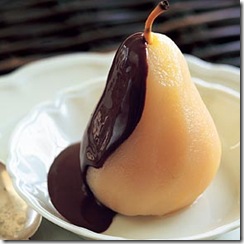
This is a recipe for poached pears with a delicious, rich chocolate sauce. The recipe comes from our French chef, Ronald, who really needs to have his own cooking show one day! We just can’t get enough of his marvelous creations that he comes up with for our Market Day Cooking Class.

Enjoy this with a port, Sauternes, or late-harvest American Riesling.

Ingredients
400 grams chocolate
1 cup milk
8 pears (preferably “Williams”)
2 tbls cream
almonds (optional)
3 tbls butter

Directions
1. Bring a large pot of water to boil. The water level should be enough that the pears are submerged.
2. Peal the pears cleanly of ALL skin.
3. Add pears to the boiling water, cover, and cook for 30-40 minutes depending on the ripeness of the pears.
4. Once the pears are cooked through, remove them and place them in a bowl with some of the water from the pot.
5. Add the chocolate, butter, and milk plus a few tablespoons of the pear water to a sauce pan over medium heat while constantly stirring.
6. Once the chocolate is melted, add 2 tablespoons of cream. Reduce heat to med-low and constantly stir.
7. If desired, almonds can be roasted in a baking dish in an oven at 300F for 10 minutes.
8. Place a ladle-full of chocolate sauce on a plate and turn the plate until the entire plate is covered. Place your pear in the middle and garnish with almonds and/or seasonal red fruit.

Author: Katherine
• Sunday, October 31st, 2010

What exactly is a sommelier?

The word “sommelier” is derived from the Late Latin term sagma, meaning “pack saddle.” In Old French, the word somier meant “pack animal.” By the 14th century, the term had evolved into “soumelier” which identified a court official who was responsible for supply transportation. No doubt wine was included in that bounty for the king’s court. At some point in history-it is not clear exactly when-the term came to refer to a steward who specialized in serving and stocking wine.

Today, a sommelier has come to designate a wine steward who possesses expert knowledge about fine wines and is responsible for serving them. Many sommeliers are highly trained professionals who have refined their knowledge of wine through dedicated study. The Court of Master Sommeliers is an internationally recognized organization that trains sommeliers. I appreciate the name of this organization, though it may sound a little self-important, because it’s a nice throwback to the old days when the sommelier was just a lowly servant of a royal court!

But the real question on everyone’s mind: how are earth do you pronounce it?! This link will give you the spot on pronunciation, with a French accent and an American accent. (The website can be a helpful resource for many other tricky words, too!) But now you can sound like a wine snob.

Author: Katherine
• Monday, October 25th, 2010

It’s the celebratory sparkling, bubbling drink that brings great taste and enjoyment to any occasion…Champagne! The carbonisation of champagne has always been one of its big selling points as it causes the “pop” of the cork and quickly brings on the party-spirt since also gets the alcohol into the bloodstream more quickly! We all know it can make your head a little fizzy. But how do those Frenchies make their bubbly…well, bubbly?

3 (French) Words: La Méthode Champenoise

The Méthode Champenoise literally means the traditional method by which Champagne wine in the Champagne region is produced. Winemakers first produce a dry white wine which can be made from 100% Chardonnay or blended with Pinot Noir, Pinot Meunier and Pinot Gris. This white is a fully finished wine that has undergone fermentation in cement or steel tanks.

But, instead of just bottling the white and calling it a day, Champagne winemakers add extra sugar and yeast to the white wine. And then, the magic happens.

Because of the additions, a second fermentation occurs inside the bottle. The yeast turn sugar into alcohol and CO2. The carbon dioxide (CO2) cannot escape from the bottle and is dissolved in the champagne, creating the bubbles.

Then, the bottles sit. They can mature, lying horizontally, for one year or 3 years or even more. When the maturation is over, there is still residual yeast and sediment in the bottle. And you don’t want that in your bubbly!

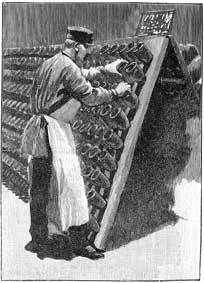
So, the yeast and sediment must be removed in a process known as riddling, “remuage” in French. Traditionally, the bottles are put into a “riddling rack” (shown below) which puts the bottles in a semi-vertical (45º exactly) position. The man below, Le Remueur, was the worker who had the unlucky task of hand turning each bottle…each day, everyday, for up to 56 days…to gently encourage all the sediment to sink down to the bottom of the bottle. After 6 weeks, the bottle is pointed straight down and the sediment consolidated at the bottom.

Le Remueur: 1889 engraving of the man engaged in the laborious daily task of turning each bottle a fraction

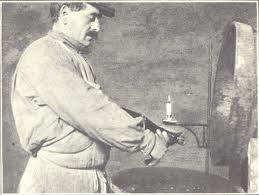
How do you get the sediment got of the bottles? Well, the bottles have to vomit it out. No joke. The French call this phase “dégorgement” meaning disgorge or vomit. The cork and the sediment are removed without losing large quantities of the liquid. What used to be a skilled manual process is now done by mechanically, freezing the neck of the bottle and removing the frozen sediment. The bottle is topped off with more Champagne and possibly added sugar for give desired sweetness and flavor.

Dégorgement by candlelight

Then it’s corked and then it’s done! But another interesting note, the cork starts out as a straight ‘tube’ shape found in all other wine bottle. It is only the pressure and system of corking that gives it its mushroom head and flared bottom that we all know and love to pop.

Encore! Let’s review:

1. Fermentation

2. Bottling

3. Second Fermentation

4. Maturation

5. Riddling or “Reumage”

5. Dégorgement & Corking

There you have it. The mystery behind the making of Champagne. Yes, it would have been easier if they just added some tonic to Chardonnay but you don’t argue with a 300 year old process created by Dom Pérignon himself.

Author: Katherine
• Wednesday, October 13th, 2010

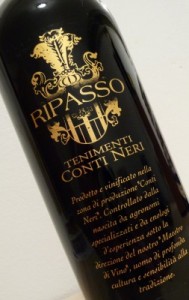
Ripasso, which literally means “repassed,” is an Italian style of winemaking. Typically, wines from the Valpolicella region in Italy are very simple and fruity, much like Beaujolais. But the ripasso process gives unremarkable wines more richness and body. With this technique, leftover grape skins and seeds are added to the batch of Valpolicella wines for a period of extended fermentation. The additional food source for the remaining fermenting yeasts helps boost the alcohol level and body of the wines while also leaching additional tannins and compounds that contribute to a wine’s complexity, flavor and color. Not to mention, a lot high alcohol content. Ripasso can have an alcohol level of 15% to crossing even the 17% mark! A wine like that is one that you don’t want to pass up.

Author: Katherine
• Friday, October 08th, 2010

Surely every wine lover has seen the fanatically humorous and cleverly scripted 2004 film, Sideways. The anti-hero, Miles, is the epitome of a wine snob with an opinionated palette. Most of you probably remember how Merlot sales plummeted in the US that year as a result of the line where Miles shouts, “If anyone orders Merlot, I’m leaving. I am not drinking any f***ing Merlot!” At the same time, Miles’ preference for Pinot led to a rise a Pinot Noir sales by 20%. For Miles, his true love was Pinot and he would never dream of sully his palette with a taste of Merlot.

But what about that that treasured bottle in Miles’ wine collection? The legendary 1961 Cheval Blanc. Ironically, he wound up drinking in a fast food restaurant out of a paper cup. But there’s another layer of irony that might have gone unnoticed by most of the audience. Chateau Cheval Blanc produces some of the best and most expensive wines in Bordeaux. And what happens to be the main grape varietal Bordeaux- Merlot. Cheval Blanc is actually a blend of Merlot and Cabernet Franc, another variety that Miles snubs in the film.

Whether this was intentionally, clever irony by the screenwriters or just another Hollywood goof, I guess we will never know. But for Miles’ sake, he should have been sitting on an old vintage from Burgundy instead.