• Friday, October 08th, 2010


Surely every wine lover has seen the fanatically humorous and cleverly scripted 2004 film, Sideways. The anti-hero, Miles, is the epitome of a wine snob with an opinionated palette. Most of you probably remember how Merlot sales plummeted in the US that year as a result of the line where Miles shouts, “If anyone orders Merlot, I’m leaving. I am not drinking any f***ing Merlot!” At the same time, Miles’ preference for Pinot led to a rise a Pinot Noir sales by 20%. For Miles, his true love was Pinot and he would never dream of sully his palette with a taste of Merlot.
But what about that that treasured bottle in Miles’ wine collection? The legendary 1961 Cheval Blanc. Ironically, he wound up drinking in a fast food restaurant out of a paper cup. But there’s another layer of irony that might have gone unnoticed by most of the audience. Chateau Cheval Blanc produces some of the best and most expensive wines in Bordeaux. And what happens to be the main grape varietal Bordeaux- Merlot. Cheval Blanc is actually a blend of Merlot and Cabernet Franc, another variety that Miles snubs in the film.
Whether this was intentionally, clever irony by the screenwriters or just another Hollywood goof, I guess we will never know. But for Miles’ sake, he should have been sitting on an old vintage from Burgundy instead.
• Monday, October 04th, 2010
As if the myriad of wine grape varietals isn’t already overwhelming enough, many varietals have other names in different countries. There are thousands of varieties out there but here is a starter list of some common grapes and their international aliases.
Cinsault (France) ——————————> Ottavianello (Italy) & Hermitage (South Africa)
Malbec (worldwide) —————————> Auxerrois/Côt (Cahors, France)
Grenache (worldwide) ————————> Alicante (Italy)
Mourvèdre (worldwide) ———————-> Monastrell (Spain)
Muscadelle (France) ————————-> Tokay (Australia)
Rolle (France) ———————————-> Vermentino/Favorita (Italy)
Petite Sirah (USA) ——————————> Durif (original, named after botanist who discovered the grape)
Pinot Gris (France & USA ) ——————-> Pinot Grigio (Italy & worldwide) & Malvoisie (Switzerland)
Pinot Noir (France & worldwide) ————> Spätburgunder (Germany)
Sauvignon Blanc (France & worldwide) —-> Fumé blanc (USA, marketed by Mondavi Winery)
Syrah (worldwide) ——————————-> Shiraz (Australia)
Trebbiano (Italy & worldwide) —————-> Ugni Blanc (France)
Zinfandel (USA) ——————————-> Primitivo (Italy)
• Monday, September 27th, 2010
Lately, when discussing and learning about wine, I been hearing this buzz word: extraction. What does this mean to the casual wine lover who might immediately visualize somebody pulling teeth when hearing that term? In the wine world, extraction is the process of taking the flavor, color and tannin out of the grape skins during maceration when the grape skins are steeped in the grape juice during fermentation. It’s a similar process to steeping tea. From extraction, the winemaker can develop the desired color, flavor and structure. Highly extracted wines are described as full-bodied, intense and alcoholic, with powerful fruit flavors and tannins. These wines are often referred to as fruit bombs and this can be a criticism if it means that the wine is out of balance. The challenge is to extract the right amount of these compounds so that the wine is still balanced. And delicious.
• Monday, September 20th, 2010

I took this photo last week while on a Chateau Tour of Châteauneuf-du-Pape. It’s harvest time in the south of France and basically all rules and norms go out the window and three weeks of organized chaos sets in. I’m sure this magnum at Domaine de Beaurenard will come in handy as the workers approach the end are in need of some kind of respite.
- Brian
• Saturday, September 18th, 2010
Everyone who loves red wine has at some point or another suffered from the purple tooth syndrome. In other words, red wine leaves you with unattractive stained teeth that is always an embarrassing feature to see in the mirror after a night out. Everyone’s first instinct to remove the stain is, of course, to brush. Or scrub vigorously! However, I recently learned from a Houston based winemaker and importer, Ryan Levy, about the correct course of action that will protect your pearly whites.
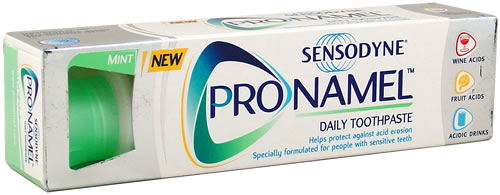
Ryan informed me that brushing your teeth after drinking is a bad idea, in fact, it can be harmful! This is because the acidity in the wine causes your teeth to be more sensitive and brushing will actually start to erode the enamel. Yikes. So he recommends just rinsing the mouth out with water. Rehydrating your mouth is essential as your own saliva is your best defense in neutralizing acid. If possible, eat a piece of cheese in between tastings because that will also neutralize the acid in your mouth. It is important to avoid brushing directly after exposure, but when it is time to brush, use a gentle toothpaste like Sensodyne ProNamel. Sensodyne is actually marketed (notice the label) as a toothpaste that will protect against wine acids.
So remember:
-Swish with water
-Eat cheese
-Avoid brushing immediately after drinking
-Use Sensydene ProNamel toothpaste
It is also important to note that acidity in all wine will wear down tooth enamel, not just red wine, so any wine lover should follow these steps. That way, you can keep teeth healthy through many a wine tastings. Otherwise, you can also drink wine through a straw.
• Tuesday, September 14th, 2010
Thought to be the oldest branded wine in the United States (dating from circa 1835), Virginia Dare was named after the first child born of English parents in America. The wine was made from a grape called scuppernong, a native variety that is still grown in the South. This white Virginia Dare was originally called Minnehaha. There was also a red wine called Pocahontas.
• Wednesday, September 01st, 2010
The concept of garage wine has been around since the mid 1990s, when a group called the garagistes in Bordeaux reacted to the traditional style of red Bordeaux wine. The garagistes developed a style more consistent with perceived international wine tastes.
Yet, what the garagistes did not reinvent was the packaging of their product. Another innovative winemaker, Anthony Hammond of Germany, recently developed the most creative new way to package wine. In fact, Hammond’s wine is produced in a former tractor shop thus giving “garage wine” a whole new meaning as well as a cutting-end image. I must admit, these look pretty slick. Just be sure not to store them in your garage next to the lawnmower.
• Saturday, August 28th, 2010
Have you ever felt the urge to drop everything- job, mortgage, responsibilities - to travel around the world? Some people might call that a mid-life crisis, others might say it’s wanderlust, but for most it is just a pipe dream that we can satisfy with escapism fiction like
Eat Pray Love. For our friend, Betsy, who recently joined us for a “Chateau Tour” in Chateauneuf-du-Pape, it is very much her reality. This vivacious, funny, and brave American woman quit her job, left town, and has been traveling Europe with the goal to do one thing a day that scares her. She has been documenting her scares and successes in a blog called “One Thing a Day That Scares Me.” It is a bucket list of sorts, where she tackles fears like driving a stick shift in France and overcoming her fear of heights by riding in a hot air balloon! We enjoyed hearing about her adventures while tasting some wonderful wines in Chateauneuf-du-Pape and admiring the vines dripping with ripes grapes almost ready for the harvest. She captured the region and three wineries we visited in some amazing pictures- with her iPhone using the Hipstamatic app no less- and is sharing them with us here. In turn, we would like to share with you the story of this incredible woman and her whirlwind journey to overcome fear in her life. Because
that is inspiring.
Read about Betsy and her bucket list at One Thing That Scares Me
• Wednesday, August 25th, 2010
Despite the recession, producers in Provence are experiencing a boom in sales of rosé wine. Provence Wine Concil shows a 28% jump in sales of imported rosé in the US in the past year. The growth in imported rosé eight times steeper than the overall growth of wine sales in the US. People see rosé as an affordable indulgence, which attainable at a reasonable $10-20 a bottle. A thirst is growing for moderately priced dry, light rosé as opposed to more expensive Malbec or Riesling.
The US market is also beginning to appreciate “true rosé wine” which is made from red grape varieties that are pressed after enough skin-to-jice contact gives a pleasing pale pink color. It is an alternative to sweeter pink wines such as white Zinfandel and red-white blush blends. This drier style of rosé currently only represent 1% of US Imports but it is steadily increasing in popularity.
The pink tide is growing, despite the current recession, and more and more people are calling out for the true rosé. I say, by all means, “Let them drink rosé!”
• Monday, August 23rd, 2010
What would fois gras be without its Sauternes? Would a pairing of Roquefort cheese and Saunternes be nearly as pleasurable without that sweet and salty combination? Personally, I cringe to even consider these unfortunate possibilities. But it seems to be a fast approaching reality.
Saunternes, the region in the Graves section of Bordeaux, is famous for its luscious sweet nectar made from Sémillon, Sauvignon Blanc, and Muscadelle grapes affected by noble rot. Noble Rot is a fungus that attacks the grapes causing them to shrivel, inducing a chemical reaction within the grapes that ultimately produces a very complex and sublime wine. Although, rotten grapes may sounds off-putting, these wrinkled grapes producing the most mouthwatering and sublime sweet Saunternes.
However, in recent years with very bad weather, a top châteaux in Sauternes may be forced to lower its standards and disappoint sweet wine lovers everywhere, making us weap while we poke despondently at our lonely fois gras. Either due to a very dry growing season in which noble rot did not develop, or because bad weather destroyed the grapes before they were harvested. In these years the grapes harvested go into making dry wine which can only be sold at a much cheaper price under the general Bordeaux AC appellation.
So quick, rush to your nearest fine wine shop or French wine importer, and enjoy a bottle of traditionally sweet and superb Sauternes!